


Dr. Chesnut's Training and Credentials: Understanding Facial Plastic Surgery Qualifications
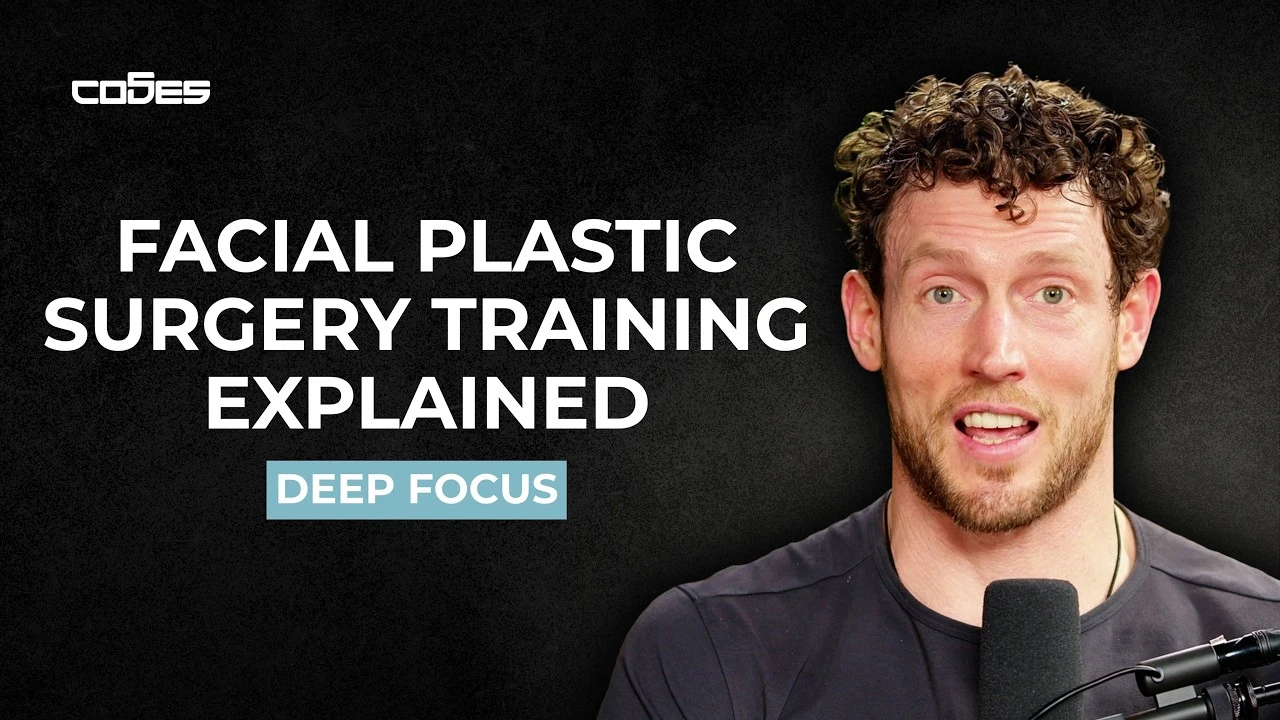
By Dr. Cameron Chesnut | Five Codes Podcast
If you've spent any time reading comments on social media about cosmetic surgery, you've probably seen a version of the same argument: "He's not a board-certified plastic surgeon." It gets dropped as though it's the final word on whether a surgeon is qualified, trustworthy, or even legitimate.
It isn't. And I want to explain why, not defensively, but because this is genuinely one of the most interesting and misunderstood stories in modern medicine.
What "Plastic Surgery" Actually Means
The word plastic, as in plastic surgery, comes from the Greek root plasticos, meaning to shape or mold. It describes a philosophy, not a specialty. At its core, plastic surgery is about reshaping and reforming human tissue. It is a set of principles that can be applied to any area of the body, and over time, different medical specialties have done exactly that.
Plastic surgery as a formal field grew out of general surgery around World War I, when surgeons were trying to reconstruct soldiers with gruesome combat injuries. It evolved for decades without formal recognition and didn't receive its first official board until the 1940s, with recognition from the American Board of Medical Specialties following about a decade later. By that point, surgeons had been doing the work for thirty or forty years before anyone handed out credentials for it.
That origin story matters because it sets up everything that happened next.
The Core Four Cosmetic Specialties
Today, when we talk about facial plastic surgery, there are four recognized medical specialties that operate in this space. They're often called the core four:
1. General plastic surgery
This is the one most people picture when they hear "plastic surgeon." It covers the full body, from breast reconstruction to hand surgery to facial procedures. Importantly, general plastic surgery is the only one of the four that does not require a subspecialty fellowship after residency.
2. Facial plastic surgery
This comes out of ear, nose, and throat (ENT) surgery. Surgeons complete their ENT residency and then do a dedicated fellowship specifically in facial plastic procedures. This fellowship is where the deep face-specific training happens.
3. Ocular plastic surgery
This comes out of ophthalmology. Surgeons with deep expertise in the eye and orbit pursue a fellowship focused on eyelid surgery, orbital reconstruction, and adjacent facial anatomy. They are extraordinarily precise in that territory.
4. Dermatology
This is where my training is rooted. Like facial plastic surgery and ocular plastic surgery, dermatology-based facial surgeons complete their base residency and then pursue a dedicated fellowship focused on the face, integrating surgical training from the other specialties.
Three of the four require a fellowship. Only general plastic surgery does not.
My Specific Training Path
My base board certification is in dermatology. That is one of the core four cosmetic specialties. From there, I completed a fellowship that was specifically and deliberately designed to be cross-trained across all four specialties.
My fellowship was based at UCLA and was fully integrated with general plastic surgery, facial plastic surgery, and ocular plastic surgery. I was in operating rooms with surgeons from all of those disciplines. I was not learning a narrow slice of one approach. I was pulling in the best of each.
Our chief of plastic surgery at UCLA actually gave me the term I still use for this: cross-pollinating. He used it as a compliment, watching me in the OR, drawing from multiple disciplines simultaneously. I've carried that word with me ever since.
Structurally, my training pathway is nearly identical to what facial plastic surgery and ocular plastic surgery look like: a rigorous foundational residency followed by an intensive, focused fellowship. The difference is simply which foundational specialty I came from.
The Numbers, Because They Matter
Fellowship training concentrates your procedural experience in a way that residency alone cannot. During my fellowship year, I performed 190 facial cosmetic procedures. That means facelifts and eyelid surgeries, in addition to all of the reconstructive work.
For context: at the time I trained, the ACGME requirement for general plastic surgery residency was 50 cosmetic procedures over five years, in any area of the body. Not just the face. Any area.
That is 10 procedures per year across five years, anywhere on the body, versus 190 face-specific procedures in one year.
I am not presenting this to disparage general plastic surgeons. Many of them go on to subspecialize deeply, some do additional fellowships, and many become extraordinary facial surgeons through years of focused practice. What the numbers illustrate is that fellowship training, whether you arrive there from ENT, ophthalmology, dermatology, or general plastics, is where the volume and depth of face-specific experience gets concentrated in a way that residency alone does not replicate.
The Board Certification Nuance That Nobody Talks About
Here is something that surprises most people: ocular plastic surgery does not have its own board certification either. Neither does dermatology-based facial surgery, even when the surgeon has done a deep, subspecialty fellowship focused entirely on facial procedures.
The only specialty in the core four that carries the word "plastic" in its board certification is general plastic surgery. The others do not, regardless of how specialized, experienced, or focused on the face they become.
So when someone says "he's not a board-certified plastic surgeon," they're technically correct. But the same sentence would apply to every ocular plastic surgeon in the country, no matter how accomplished. The word plastic is not in their board certification either. That doesn't make them unqualified. It means they came from a different foundational specialty into the same subspecialty work.
My fellowship did allow me to earn board certification in Micrographic Dermatologic Surgery (MDS) and to become a member of the American Academy of Facial Plastic and Reconstructive Surgery, which is the largest and most respected professional society in facial plastic surgery. I am actively involved there, including teaching within the organization.
The Training Pathway as an Alloy
The way I think about what my training produced is the concept of an alloy. An alloy is a combination of different elements where the resulting material is stronger, more durable, and higher performing than any of the base materials on their own.
My training pulled from four directions: the precision of ocular plastic surgery, the structural depth of facial plastic surgery, the broad reconstructive knowledge of general plastic surgery, and the skin and tissue expertise of dermatology. Combined into one focused practice, that cross-pollination creates something that no single-track pathway fully replicates.
That's not a boast. It's a description of how the training was designed and why I am grateful for it.
What the Best Surgeons Are Actually Focused On
Something I've observed consistently over 12 years: surgeons who are operating at the highest level of this field spend almost no time talking about training titles. They are focused on their results, their long-term outcomes, and how to keep getting better. The conversation about background and credentials tends to be loudest among people who are not producing the most exceptional work.
Ben Talei and Ritu Chopra are a good example of what the opposite of turf warfare looks like. One is from facial plastic surgery, one from general plastics. They quite literally broke down the walls between their practices, shared techniques, and collectively advanced the field of deep plane facelifting. The results they're producing are what made that collaboration worth having. Nobody cared which residency either of them did.
I have colleagues in ocular plastic surgery, facial plastic surgery, and general plastic surgery who come into my operating room to learn. I go into theirs. The doors are open because the shared goal is better outcomes for patients, and that goal doesn't care about training labels.
James Clear, the author of Atomic Habits, describes this kind of thinking as T-shaped: a deep vertical expertise in your craft, and a wide horizontal reach that pulls in from adjacent and even unrelated fields. My vertical is twelve years of exclusive focus on facial surgery. My horizontal has expanded over time into regenerative medicine, functional medicine, neurobiology, and even the performance mindset I've borrowed from athletes I admire. Both parts of that T keep getting sharper and wider simultaneously.
What to Actually Ask When Choosing a Surgeon
If you're researching a surgeon and trying to figure out whether they're the right person for your procedure, here are the questions that will actually tell you something useful:
What do their results look like, and how do they hold up over time? Before and after photos are a starting point. Long-term results, patients showing outcomes years after surgery, tell you much more.
Are they exclusively focused on the face? A surgeon who does facelifts, breast augmentations, rhinoplasties, and body contouring on the same day is dividing their attention. A surgeon whose entire practice is the face has a different depth of pattern recognition.
What does their fellowship training look like? Not just which residency, but what the fellowship specifically included, how many procedures they performed, and which specialties they trained alongside.
What is their mindset around the work? Are they iterating, journaling their outcomes, constantly studying their results? Or are they largely doing the same procedure the same way they learned it ten years ago?
What does the process look like around the surgery itself? Preparation, recovery, the relationship they build with you as a patient. Surgery doesn't begin in the operating room and it doesn't end when you leave recovery.
I keep a detailed journal after every procedure I perform. Months later, when I see the results, I cross-reference with my own notes and look for what I can learn and refine. That process has been running for twelve years. It is not the same thing done repeatedly. It is deliberate iteration with the explicit goal of producing better and better long-term outcomes.
The Bigger Picture
Medicine has always evolved through exactly this kind of boundary crossing. Blepharoplasty was the domain of general plastic surgery until ocular plastic surgeons came in, owned it, and innovated the scarless transconjunctival approach that is now considered the superior technique. Deep plane facelifting advanced significantly when the walls between facial plastic and general plastic surgery started coming down rather than going up.
The history of plastic surgery itself is a story of a specialty that spent decades doing important work before it was formally recognized, certified, or titled. The work preceded the credential, and the credential followed the results.
My practice has been built entirely on that same logic: the results are the argument.
Frequently Asked Questions
Can a dermatologist perform facelift surgery?
It depends entirely on their training. A general dermatologist has not done a surgical fellowship and is not trained in facelift surgery. A dermatologist who has completed a subspecialty fellowship specifically incorporating facelift surgery, eyelid surgery, and facial reconstruction (as I did) has. The dermatology board certification is the foundation, not the ceiling. What matters is what fellowship training followed it and how extensively face-specific surgical procedures were part of that training.
What are the core four cosmetic specialties?
The four specialties from which surgeons can legitimately develop facial aesthetic expertise are: general plastic surgery, otolaryngology (ENT) leading to facial plastic surgery, ophthalmology leading to ocular plastic surgery, and dermatology. Each requires a different path to develop deep facial surgical competency, and fellowship training after the base residency is what determines the depth of that specialization.
What is the American Academy of Facial Plastic and Reconstructive Surgery (AAFPRS)?
The AAFPRS is the professional society dedicated to facial plastic surgery. Membership requires meeting criteria related to training, experience, and commitment to facial plastic surgery as a specialty. It was established largely by ENT-trained surgeons who fought to establish their legitimacy in facial surgery, and it has become the standard-setting body for the field. I am an active member, including serving in a teaching capacity.
Is fellowship training required to perform cosmetic surgery?
It depends on the specialty. General plastic surgery does not require fellowship training in cosmetic surgery. In fact, the minimum requirement for cosmetic procedures in the residency is 50 cases over five years, with no face-specific requirement. ENT surgeons who want to practice facial plastic surgery complete a dedicated fellowship. Ophthalmologists who practice oculoplastic surgery complete a dedicated fellowship. Dermatologists who pursue deep facial surgical training complete a fellowship. Fellowship training is where true subspecialization happens, and it is one of the most meaningful variables in evaluating a surgeon's preparation.
Why do some surgeons focus on credentials rather than results?
Credentials provide a baseline floor of training, which is genuinely important. But in the hands of surgeons who are not producing excellent outcomes, they become a substitute for the harder work of demonstrating excellence through results over time. At the highest level of the field, among the surgeons I most respect and who most respect each other, the conversation is about outcomes, innovation, and what we can learn from each other. The credential conversation tends to be loudest among those who are not in that conversation.
What questions should I actually ask a surgeon before a procedure?
Ask to see a broad, consistent body of results, not just highlights. Ask what percentage of their practice is dedicated to the procedure you're considering. Ask how long they have been doing it, how they continue to refine their approach, and what they do to prepare for each patient specifically. Ask about their recovery protocols and what happens after the procedure. Ask whether they operate in an accredited facility. A surgeon who welcomes all of these questions and answers them with specificity and transparency is giving you far more information than any title alone can provide.
Related reading:
- What I Believe the Future of Facial Surgery Actually Requires
- Natural Facial Rejuvenation Philosophy
- How to Choose a Facial Plastic Surgeon: 10 Questions That Actually Matter
- Who Is (and Is Not) a Good Candidate for Facial Cosmetic Surgery
- Beyond the Deep Plane Facelift: The Next Frontier of Facial Lifting
- Accredited Surgery Centers: Why They Matter
Dr. Cameron Chesnut is a facial plastic surgeon and founder of Clinic 5C. He holds a clinical teaching affiliation with the University of Washington School of Medicine. The views expressed here are his own and are not affiliated with or representative of that affiliation. This content is for general educational purposes only and is not individual medical advice.
.avif)
Ready to begin your wellness journey?
Fax: (844) 961-3417